There is a post I keep trying to write and it never quite comes together. We’ll see how far this one gets.
There are emotional horizons beyond that of love. As deep, broad, and intense as sacred love is there are things that lie on its other side. And there are things beyond that still – or so I trust.
Extreme sensations, no matter how sweet or pleasurable turn into pain eventually and when there is no relief or culmination or resolution all that pain turns into a kind of drawn out grief. No one talks to us about love so intense and outsized that it becomes its own source of tragedy.
I write so little about Him here that people actually don’t realize that He’s my primary focus in life. It is much, much easier to write about other topics and those are what people gradually know me best for talking about.
I’ve spent the last several years lost in medieval Indian love poetry because I have no source of emotional refuge closer to home. My religious leaders certainly didn’t talk about what happens after love.
The thing is, I don’t know how to cope with or manage this experience. It is drawn out like hot wire, fine and burning and bright and dangerous to hold. What do you do with this kind of emotion? My only response has been to melt and wave after wave of sentiment surges out and I cry all the time.
**
One of the people I rely on for instruction (I wish I could remember specifically who) said that there’s a good reason people are so wary of religious life. When you shack up with a path you might very well find your life going to shit before very long – and yeah, it’s not too inaccurate to say that religion is the source of the problem. See, when you suddenly rearrange your priorities in a way that will always leave you fundamentally disappointed and frustrated, you will always find life and lived experiences somewhat lacking. For instance, if your religious worldview includes charity as a priority and you go through each and every day surrounded by greed and selfishness, you will naturally end up disappointed and frustrated. If your religious worldview prioritizes a view of humanity as fundamentally connected and interdependent and you see nothing by people talking about how we don’t have to care for one another, you will naturally end up disappointed and frustrated.
The problem isn’t religion as such – and in fact, since this is an entirely natural outcome of religious engagement, I’m not sure it can be considered a problem at all. The difficulty arises from being forced to exist in contexts where our highest goals will be impossible to achieve or realize – and this, perhaps, is the entire point. Trying to force consensus reality to conform to a present, private understanding of a religious paradigm is misguided at best and abusive at worst.
Being in a context suffused with tension between desire and resolution, interior reality and exterior reality, is intensely painful and we have a choice regarding how to deal with this pain. We can lash out and harm others as they inevitably fail to live up to our private ideals; telling others that they aren’t pious enough, aren’t devoted enough, aren’t pure enough, aren’t driven enough, aren’t educated enough, aren’t committed enough, etc. etc. doesn’t actually inspire many people to adopt a religious worldview and certainly doesn’t further the resolution of one’s private desires. Others’ “failure” to conform to our private priorities isn’t a flaw in the system. It’s a feature; a lesson; an opportunity to shut up and recognize that everyone is currently suffering or will eventually suffer from the same failure to resolve the tension between private desire and consensus reality.
What I’m saying is that we can choose to learn from this tension, this “problem” or we can hurt ourselves and others with it.
I struggle with this. I prioritize the sacred relationships in my life and feel them with such intensity that I can have little patience for the small, nuanced, and delicate ways that interpersonal ties are formed and sustained. I am not always a very good friend. I am not always very patient with the ways interpersonal ties are expressed. I have failed to be compassionate and patient and without doubt I will continue to fail.
This failure isn’t a flaw; the flaw exists only in me demanding that all other versions of reality conform to my interior priorities. It doesn’t mean that I’m wrong or bad, merely that I still have much to learn.
I don’t feel like this love lives in me; I feel like I live in it, moving through it like a cloud or bank of fog every day. This outsized love is painful enough that it feels like a flaw, like a problem, like a burden – but just because it feels this way doesn’t mean it is.
My life has been ruined by religion. I’ve been shredded to pieces and beaten down until I don’t recognize the person I was or am or might someday be. The little markers that gave me gravity and a place to sit are long gone and I have no idea where I fit or where I belong. I have loved long past the point of pain and I don’t know how to stop. I thought about stopping and even tried for a while but found that the world of dry and empty and bland. I don’t know precisely how to channel this intensity or how to find relief; nothing seems to fix it for long.
“My ruination,” I call Him.
And yet I persist – not out of any nobility of purpose but only because I don’t know how to stop.
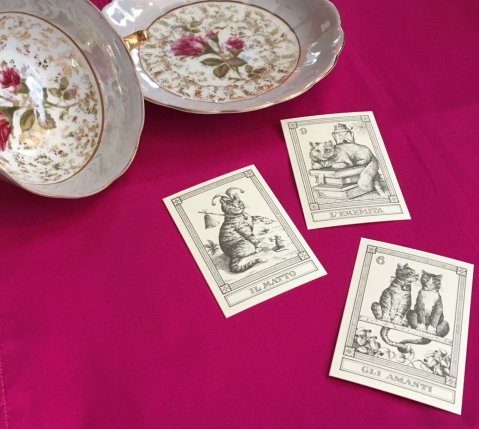
 Instead of focusing on tarot or even oracle cards (both of which are thoroughly represented in the market) I decided to emphasize my tea leaf reading. Scrying was a skill I fell backwards into. I never thought I had the knack until I started working with coffee grounds and tea leaves. Tasseomancy, it seems, is something that works for me. So I’m marketing myself primarily as a tea leaf reader with cartomancy as a secondary offering. I’m excited! I like scrying. (I can also use mirrors and black reflective surfaces too but it gets intense and I don’t want to haul that in front of the public; cups of tea are more approachable. That said, it would be good to have an actual crystal ball to work with! Maybe someday.)


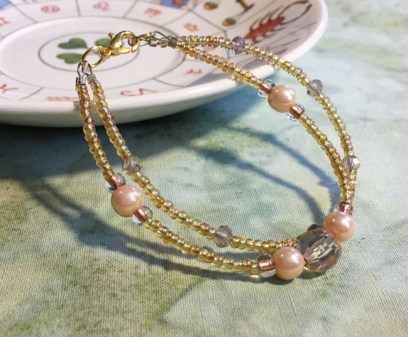 I am, however, fairly busy on social media because in some ways it’s easier. I don’t want to fill my blog with Etsy shop updates (




 The Road, the Walker, and What Comes Next