Site Maintenance Notice

Things have been a little busy behind the scenes here (hence my delay in replying to recent comments; sorry, everyone). I’m in the process of moving my WordPress site to something a little more stable and dynamic but hopefully it will result in few or no changes on the front end of things. I’ll let you know when the dust has settled.

In the meantime, you can watch for a little sidebar gauge that will track the progress of Further Along the Heartroad. This little ticker will help me stay on track and will let you guys know that I really am truly working on this thing. Stay tuned!

Changing in Response

For many years I’ve observed a strong crossover between devotional practitioners and spirit workers. In the grand Venn diagram of my personal informal observational study, there is considerable shared territory. It’s not absolute or even predominate; it’s maybe 50/50. That is – about half of devotional practitioners are likely to have some sort of spirit work calling going on and about half of spirit workers are likely to have a strong devotional streak to what they do. (However, I do believe that one is not necessarily likely to predict the other and I’ve not really noticed any firm or reliable trends that predict either. Devotional inclinations develop along the lines of personality usually and spirit work, well, that’s for the Gods to decide, isn’t it?)

My spirit work is strongly expressed through emotional connection and the language of relationship; my life as a devotionalist is indelibly shaped by the fact of my existence as a spirit worker. I imagine that this situation is familiar to many of my readers. Despite the analytic seduction of this particular correlation I have rarely found any firm connective tissue that would tie the two together in a manner that would be meaningful to anyone else.

However, I recently uncovered a little tidbit that might tie these two worlds together a little more strongly – at least in some cases. I do maintain that the path of the spirit worker and the path of the devotionalist are different enough that we need not explain one in terms of the other; similarly, a person should never feel pressured or under the assumption that one path indicates the emergence of the other. (While I do have opinions about how closely they are related in a spiritual and karmic sense, those are simply opinions and thus are always changing and not terribly reliable.) All those disclaimers said, here’s a little sample of what I discovered.

I found that in certain cases of extreme devotional fervor, in intense moods of separation and love in particular, the physical bodies of devotees are said to have changed somehow. Some of these changes are mythical in their extremity (like the shrinking of limbs) but those highly visible changes are built up to with more subtle changes over a long period of time. These smaller changes are both the response to the extreme emotions of the devotees and evidence of these feelings. Perhaps most tellingly, there is a precedent for increased physical sensitivity in the devotees.

Heightened sensitivity is nothing new to many of the long-term devotional practitioners I know. Sensitivity to environmental stressors seem to be the most frequently experienced. Light, noise, the press of people, and even various psychic and spiritual forces are causes of overstimulation, discomfort, distress, and general discontent and anxiety for a number of people I know. Some of this is personality but some of it….well.

Spirit workers are quite familiar with the understanding that the path changes them merely as a natural outcome of engagement. It is inevitable. Some of these changes are referred to as mods or modifications, spiritual (or not-so-spiritual) adjustments that make us better able to execute the particular tasks we’re called for. Though mods are (or used to be) spoken of as deliberate alterations that the Powers initiate, modification happens on its own. We grow a new spiritual (or not-so-spiritual) body in response to the demands of the path and our engagement with it. I’ve personally developed a handful of food sensitivities that I feel are pretty closely related to the Work. A friend speculated that the weird, undiagnosed physical ailments I live with are one manifestation of the frustrated shaman’s path I’m part of. Maybe, maybe not. There are precious few spiritual clinicians out there that can diagnose these things. But anyway.

Finding an acknowledgement that devotional practice carries the potential for profound and subtle transformations was actually quite significant for me. Yes, there seems to be little reason to expect an intense spiritual path to *not* change a person and indeed, there is plenty of anecdotal evidence within our contemporary pagan and polytheistic communities to support this. Even in more magical currents, including traditional witchcraft, sabbatic trads, and Western mystery stuff, you find the acknowledgement that people are changed in some way by having emotional ties with Powers. (These are usually discussed in terms of magical powers obtained through the company of a spirit, but change is change.) But see, I study devotional practice. I specifically study devotional practice in the context of bhakti and modern paganism. In many ways bhakti is my guidebook. I rely on this tradition of generations of devotional experts to provide a certain guidance through what I’m experiencing here and now. I don’t mistake what I’m doing for bhakti, but bhakti helps me make sense of what’s happening in my life. So when the tradition that has taught me says, “Hey, your longing and love for the Divine really does change your shit”, it’s significant to me.

This is a pretty new little discovery and I’ll need to do some more digging before I can really share more details on it. For now I’ll offer this to my fellow Heartroad-ers: Yes, your love and longing is real to this world and others. Yes, your physical existence is shaped by the company you keep. Yes, these transformations are sacred and they are the scripture that your life is writing. And yes, the frightening and monstrous and disturbing transformations we endure are all the more beautiful and profound because they are proof that we participate in a love that is stronger than life as we understand it.

Someday I’ll write about how I’ve become my own proof of the Gods. Someday I’ll talk more about my weird gold eyes.

Mystic Love; intermission

Wow, I really hadn’t expected such a response to my little post about mystic love. I’ll finish it up at with the rest of my current thoughts at some point but right now I’m mentally drained from the exertion of the weekend. (The local presentation of my PCon session went well and I got some good feedback; this will make the real thing even better.) To thank everyone for their signal boosting and interaction with my tiny blog I’d like to share the YouTube movie on Meera’s life that I’m currently watching. Unlike the other two that I like, this one is in Tamil and is considerably older (1945). It’s fun for lots of reasons. The girl playing young Mirabai is appropriately cute, as is the older actress. Adult Meera has lots of disinterested expressions for her mortal  husband and bears his attentions with humorous impatience. We also get several Tamil devotional bhajans instead of the Gujarati bhajans that are typical of Mirabai movies so that’s cool; I lovelovelove the traditional ones but it’s fun to explore additional songs, too. Andal is also mentioned in passing, yay! To see the English captions, just turn on the CC option.

Something that always impacts me about Meera’s story is that as a queen, she had absolutely everything. Up to the point of her renunciation she never had a moment of want. She even got a temple built to her Beloved (at least she does in many of the movies about her life, including this one). Regardless of all this plenty, she still suffered. Even in the most ideal of circumstances, her search for Krishna was challenged at every turn. No one has it easy on this path; this is simply because the mystic’s path is not an easy one. It is so easy to feel downright oppressed at the difficulties facing our individual searches. I strongly believe that these feelings of frustration shouldn’t be taken as an indication that the search for the Beloved is fruitless or impossible or that we’re just not meant to find Them. This is just the nature of the path and it has to be accepted as such. I’m sorry it hurts. I’m sorry for myself and for you and for Meera and for all of us who suffer from this very precise form of loneliness and hurt. But this path also leads me closer to my Beloved and so I have to bless it.

Anyway, enjoy.

PS: I’m sorry that I don’t have any info about the distribution or current copyright holder of this film. IMDB doesn’t have any helpful info on this count either. There are some channels on YT that seem to be authorized by specific distros (Shemaroo is a big one and their channel includes a Meera movie) that you can explore further.

Mystic Love, Mystic Priorities

Last night I had a long talk with some friends about some of the more prominent aspects of my private spiritual life. This conversation had been waiting to happen for a while but my private spiritual life isn’t something that I can just dump on unsuspecting acquaintances; you gotta work up to that level of disclosure. Even though I’ve known for a while that these people were safe to talk to about these things, the time had never been right for the conversation until now.

We talked about a lot of things but about the mystic’s path in particular. I’ve been thinking about this for a while and never was quite able to put it into words until now. Objectively I recognize that there is much of the mystic about me but it’s not really the path that I identify with. I am, perhaps, too aware of my functional capacities, my nature as a spirit worker, to relate most strongly to my search for the variant faces of my Beloved. (“But,” the heart whispers, “might you not be approaching this search through the vehicle of the Work?” Hush, I whisper back, or you’ll spoil the ending.)

Mystics are relentlessly driven to see the face of the Beloved. Sometimes this face is singular and sometimes this face is manifold. Sometimes there is a highly specific name and sometimes there is not. Further, to one degree or another, mystics seem to be able to hold the tension between specificity and the expansive sacred All. Holding this tension is sometimes sweet, sometimes incomparably bitter. Recognizing that all personalized divinity suffers from restrictive particulars can be frustrating because the mystic has a strong desire to have that personalized connection. Many are able to find a personalized connection to that sacred All and others find the sacred All in a personalized connection. Others (like myself) are pushed to fall in love again and again with apparently disparate expressions of the Beloved and Hir machinations but many others have struggled and still are struggling to resolve that tension. It is challenging to be aware of an immense, pervasive, inescapable foundation of sacred nature-awareness while also needing, really needing, that highly personal connection.

The challenges on this path are numerous. Frequently mystics are not in a cultural or religious context that allows them the freedom to express themselves or pursue their search without obstacle. Indeed, the negotiation of obstacles is a primary characteristic of this path. Mirabai in many ways is my favorite mystic and the one whose story I find most helpful and instructive. Her entire life was a series of obstacles in the way of getting what she wanted and of simply enjoying what she had. This is pretty typical, actually. Mystics’ stories are not generally happy ones, even though their private lives are distinguished by intense, life-changing ecstasies. There simply aren’t that many happy or satisfied mystics and saints. (Although wait – those God-realized saints of some traditions absolutely do have that profound bliss but most mystics seem not to fall into that category. Thus I will have to set that small category aside; the mystic is characterized by the search, the God-realized saints by the finding and abiding.)

Another significant set of challenges arise because the mystic has a fundamentally different set of priorities than everyone else. Negotiating and renegotiating these priorities with the circumstances imposed by the world, by the social context, and simply by the human condition an ongoing problem for mystics. Even those who successfully separate themselves from the priorities imposed by others (usually simply by just fucking off into the forest for decades at a time) face the deep consequences of that separation. It is quite rare to find a set of circumstances that allow for the material, psychological, emotional, and spiritual support of someone whose priorities are fixed on deep emotional connection with the divine. It does happen, but most mystics have to juggle their priorities without a full spectrum of meaningful support.

There’s more I’ll write on this subject but I’m going to catch another few hours of sleep first.

Almost Ready for PCon in SLC

Well, I’m down to the last couple days before my local presentation of my PantheaCon session. I started doing this in anticipation of my 2014 session and spoke to a small, four-person audience at a nearby branch of the public library. It was a very productive experience and I got some valuable feedback from it. Sharing this session with my local community gives me practice with the material as well as an opportunity to identify problem spots. And naturally, I like being able to give back something to the people who have supported me in my various research efforts; it’s nice to bring just a little taste of PCon to the SLC area.

I’ve spent part of this year studying with a local OTO body because I wanted to broaden my knowledge of the Gnostic Mass in particular. This journey has been quite enriching and I feel like I’ve gained some valuable information in this short time. Precisely how long I’ll continue to study with them I’m not sure. For a hot minute I considered joining the group but I’m not prepared to jump into anything. If nothing else, I feel positively about continuing my association with them as a non-initiate.

My presentation will take place Friday night at a local metaphysics shop and with any luck I’ll have a pretty OK turnout. The whole event is scheduled for two hours, so I’ve planned 90 minutes for the presentation and the rest of the time for Q & A. I’m close to being prepared; I need to finish revising my notes, print them out, and then do some practicing but the bulk of the work is done. Of course, I’ve got my day job and my writing job to take care of in the meantime…

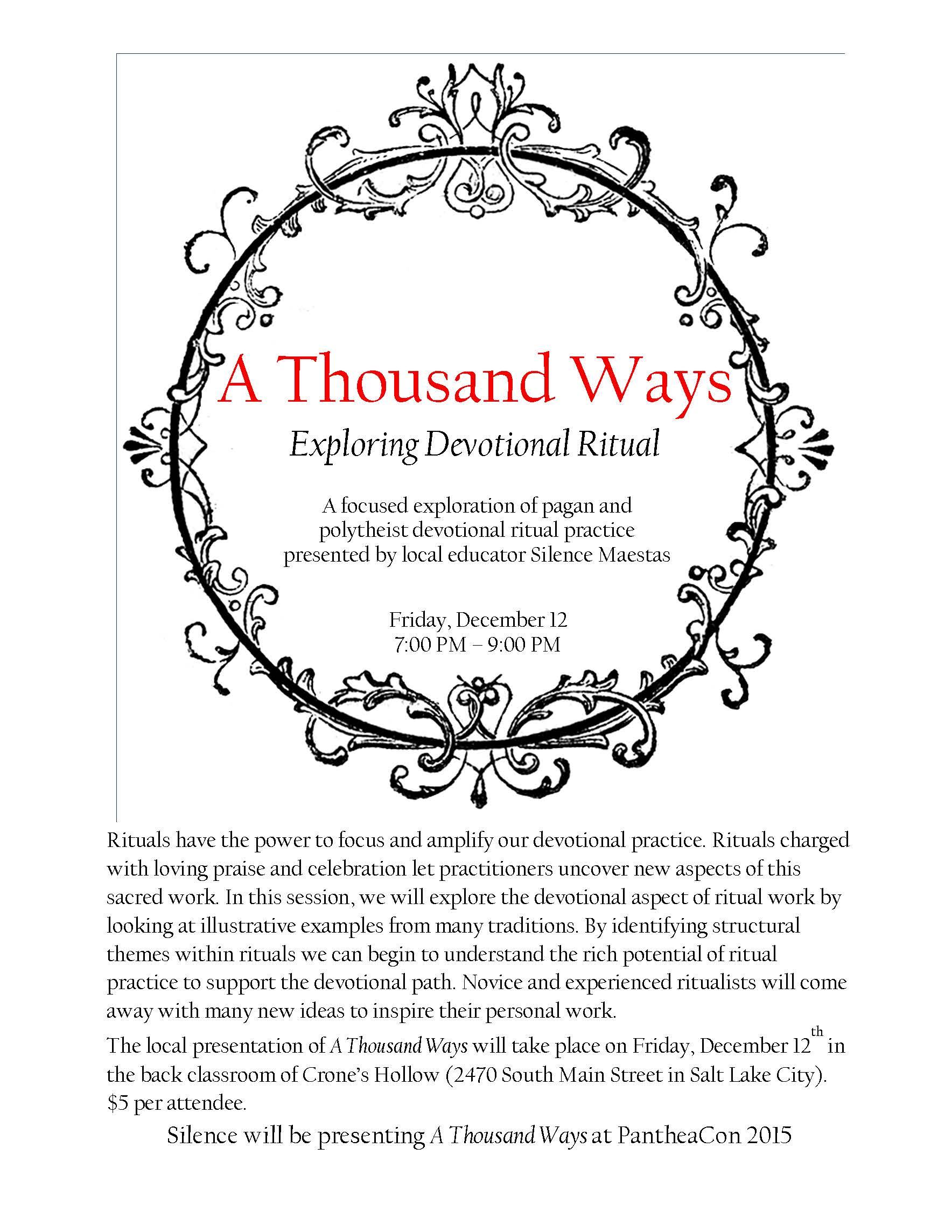
At any rate, here’s the flyer I made to help promote the event locally. I’ll change it up a bit for February. I’ll let you know how the class goes once I’m on the other side of it. Plus, I might have some news about another conference I’d like to present at but let me get this off my plate before I talk about the next big project I want to launch myself into.

a thousand ways flyer 2015

Resistance and Resilience

My personal near-daily practice is relatively formal compared to the sort of rituals I imagine other people do on a near-daily basis. There is generally a cleansing stage (a shower optimally or a thorough hand and face washing and teeth brushing otherwise) and a preliminary cleaning stage (sweeping the ritual space). I change into my ritual clothes because I have those now. Everything is ready to roll because after I finished last night’s worship I clean the implements and get them ready for use. I have a playlist that I use to get in touch with more elusive Powers or to focus my intent if I’ve been absent for more than several days and need to catch Their attention again. Offerings of light and incense are followed by short prayers and, ideally, some japa meditation. The whole thing can take anywhere from about 10 – 30 minutes depending on exactly what I’m doing or longer if I turn up the formality another notch. Spending 30 minutes in my main ritual isn’t all that long to me and I always want to do moremoremore. I *like* my daily practice a great deal and it only takes a couple skipped days before I seriously miss it.

All that said, I can be super resistant to getting anything done. My personal goal is to do one thing every day. This one thing can be my ritual practice, it can be yoga, it can be a meditation session, it can even be just writing in my magical journal or even just pulling up a devotional bhajan on YT and focusing on that for a few minutes. I’ve had to get a little creative with my approach to daily work because there are all kinds of reasons why spending 10 – 30 minutes in front of the altar or in meditation or doing yoga or even writing in a journal is simply not going to happen. Sometimes I’m really sick and literally cannot physically stand up. Some days sitting up is hard.

But there are days, like today, where everything is about as optimal as it ever is but where I still can’t get through the resistance. I don’t know where this resistance comes from and I know I’m not alone in experiencing it. I know lots of other devotional types struggle to maintain the kind of frequency or intensity their practice requires in order to progress (and/or to please the Powers and/or to maintain your health on all levels, and/or etc. etc. etc.). This resistance happens even when we want more than anything to be at the altar.

I can hear some people saying, “But WHY am I so resistant? It’s really important for me to understand!” I can hear you saying it because I’ve said it myself, lots of times. I still say it sometimes. I also know that (in my case at least) demanding understanding is at best an excuse and at worst a justification for not going forward anyway. Understanding will only come with effort. There are no shortcuts in this. If you (I) want to understand your (my) own self-generated obstacles to action, then you (I) have to engage.

There are times when deep psychological work is called for. This might not be one of them.

My action is not predicated upon my understanding; the gradual unfolding of personal insight comes only after prolonged and persistent effort. 

Resistance to practice is common, more common than you might ever imagine. Resilience is also common, because a resilient practice is what results from engaging with your own resistance. One of the most significant and profound things I’ve learned in my spirit work and devotional practices is that this work will sustain me. It will keep my focused and balanced and healed on a deep, very subtle level. It will teach me and continue to teach me so long as I continue to show up to class. I keep falling down and playing hooky and breaking the pattern but for the most part I’ve kept coming back. This comforts me.

Letter to a New Spirit Worker

Dear you,

I can’t imagine what you are experiencing right now because your growth process is unlike any others. This is the first and greatest and perhaps most difficult lesson of all: You walk this path alone. You will have allies and companions and perhaps even friends along the way who will offer support and care but you will always ultimately be alone. This truth is difficult to manage but becoming comfortable with solitude will give you the mental space required to puzzle out the challenges that come ahead. Your longing for teachers and mentors is not just a desire for guidance or meaning or even instruction; it is a desire for validation and empirical support as well as the comfort of someone pointing out what you have done well and what you need to improve on. This will not happen. Whatever teachers and mentors this path makes available to you will serve their purpose and then move on. You will gradually learn to be honest about your desires and to acknowledge the self-serving aspects of your goals and ambitions as well as the more altruistic ones.

Since every spirit worker’s path is entirely unique, looking too hard at the practice of anyone else isn’t helpful. You will learn from your peers and they from you but no one will be forced into the position of a teacher through voyeurism. Looking for more of that validation from your peers isn’t helpful and is likely to cause a lot of problems in your education.

These first several years are going to be marked by poor decisions. You will learn to take responsibility for your choices the hard way. You will gradually hold yourself to a higher standard. You will grow a sense of ethical compassion or you will continually find yourself alienating the very people you’re supposed to serve. Falling into the position of self-sacrificing martyr or brittle and grumpy outsider does not place your service in reach of people who need it. This is also true of Gods, spirits, and all the rest. They will not be able to find you or catch your attention if your effort is bleeding out in gushes or bricked up behind a wall. A middle path must be created that allows your efforts and energies appropriately measured expression while still protecting yourself from exploitation. Ethical compassion is the hallmark of this achievement and will be continually developed and refined.

This path is difficult for all kinds of reasons but you will find that it develops into your greatest comfort and support. The validation you look for from other peoples will eventually come to you from the path itself. The rhythm of your practice will uplift you and its unfolding expression will point the way. This path has an inherent intelligence that will impart its lessons directly to you as they are needed. Trying to know the whole picture now is pointless. There is no big picture (except, perhaps, the advancement of compassion and liberation). There is only a pattern that weaves through you and with you. You have the precious opportunity to become a conscious and vital part of this ever-expanding pattern. Just try to relax and focus on today. The Work will show you the rest.

Sincerely,

Silence

The Temple and the Hedge

My personal paganism is situated in two contexts: the temple and the hedge. I’m not fully, exclusively, a part of either. I’m not fully, completely, a part of both. I draw comfort and inspiration and instruction from both.

In the past I’ve been very hedge oriented, lots of outdoor time, lots of time spent looking at the sky and the trees and the dirt and the water. Lots of encounters with the wild things that go about their business without our knowledge. I miss the hedge, sometimes painfully. I miss how easy it was to step into the Otherworld when close to those powers.

These days I’m very temple oriented. It’s been this way for several years, since I’ve been living in urban areas in spaces with lots of other people in the same space. I’ve come to appreciate the fine art of altar keeping and the cycle of activity and rest that a temple keeps. There is some work that is exceptionally well-suited to temple spaces; my work with Sri Lalita Tripura Sundari Sodashi Kamakhya is one example. It would be hard to manage all my tools in a wild space and it’d be hard to maintain the fussy ritual purity that much of this work requires. (This isn’t to say that wild spaces are impure, but they have different energies and those energies are not always terribly conducive to this particular work at this particular time.) Additionally, the tantric tradition I’m a lay member of (that is, not initiated) has a strong temple orientation, based as it is on the Shakti Pitha system (though the pithas are typically natural formations there is a system of temples that has sprung up at these sites to accommodate the needs of worshipers). Yeah, there’s some tantra that’s performed in various wild and lonely places but I’m not anywhere near that stage with my practice.

I love the hedge. I miss the hedge. I miss the things that live there. (“The things,” said Ford, “are also people.”) My beloved plant allies are often on my mind which I suppose indicates that I’m still on theirs. There were several reasons why I stopped doing that work. A big part of it was being at college, living in a dorm, dealing with a part time job and a full time class load. Another significant part was being away from the plants themselves. I had a healthy crop of belladonna for a while and later a little datura plant but they gradually died. I have a mess of seeds another plant worker gave me a long time ago but I haven’t had much luck getting anything to grow; I’m going to try again in the next couple months, though. I also had to focus intensely on another very different aspect of my work and didn’t have the time or energy or attention for the kind of rigorous practice the plants require. Someday though.

I think about moving back to the country, back to the desert. I miss the dryness and the expanse and the unbearable light and the colors. Maybe someday I will live in a more rural area. I think I’d like it a lot but I’d have to work out things like reasonable employment, cell reception, reasonable access to the health care I need, and stuff like that. I’d also like to be not too far away from an urban center where I could go places and do things when I want to. I like cities – well, I like the one I live in at any rate – but I miss the country. I miss the hedge. It’s a temple of a different kind and I want to be there, too.

Presenting at PantheaCon 2015!!

Good news, everyone! I’m very happy to announce that my programming submission for PantheaCon 2015 was accepted. I’ll be presenting at PCon for the second time next February! This is a very exciting opportunity for me for lots of reasons and I hope that if you’re at the convention that you will consider coming to my session on Sunday at 3:30.

My session is called A Thousand Ways: Exploring Devotional Ritual. It’s a revision of the material I presented last year. With any luck I will have made the material much more approachable than it was last year. Though I still feel very positively about the material I prepared I think I tried to pack too much information into the time available and left some people in the dust because of it. My aim this year is to keep the material engaging for experienced practitioners without entirely alienating newcomers to the path.

As usual, I will be taking a pragmatic approach. I like empowering people with information that can be applied in direct and practical ways. Though the theoretical underpinnings of ritual, devotion, and spirituality are important and certainly interesting to talk about, the practitioner will encounter a great deal of this information on their own simply by putting in the time. Besides, the greater Pagan community is generally more practice-oriented than theory oriented and ritual is very much about the “doing”.

At any rate, I’m very happy to be returning to a convention at which I had a very positive experience. I don’t get to travel as frequently as I’d like to and being away from home in an unfamiliar environment for several days was a major sacrifice. It was worth the effort and I’m more confident about my attendance this year. (That said, I’m dealing with all kinds of emotional reactions to the news that I am, in fact, presenting again! So much self-doubt, you guys!) I love to teach and the opportunity to share in-depth information with such a diverse group of participants is very special to me. I’m very grateful to everyone who has supported my work.

If you’re not going to be at PCon and if you just happen to be near the Salt Lake City area, I’ll be presenting a trial run of the new session sometime in December or January (time/place still to be determined). The workshop will be offered in an open, public space though a small entrance fee may be charged by the site (not by me). I’ll post those details once they’re worked out.

Do we need ritual tools? Do our gods need them?

If you had come to me three or four years ago and asked, “Are tools a necessary part of worship? Do the Gods need them? Is it important that we use them?” I would have said, “Eh, not so much.” I would have said that tools are useful when helping focus attention (and thus energy) and play a key role in helping create a ritual mood for us to experience during worship or workings. I would have certainly acknowledged that even though our intent is the gasoline that fuels the engine of our spiritual art and craft, tools are a very helpful way to help stir that intention – but not perhaps strictly necessary.

I also would have said that no, the Gods don’t *need* these tools, not in any realistic sense. Objects don’t much serve the Gods – but objects can serve the people that serve the Gods and therefore the Gods may sometimes desire them. Gods might desire objects for functional reasons, for aesthetic reasons, as vehicles to interact with their people, as points of power to become established in this world – all very important but not perhaps a need, exactly.

Today I have a slightly different answer. I hold all the above statements to still be true and valid and helpful answers but I have come to learn two additional answers that go along with these questions.

Yes, sometimes tools are necessary. Tools are frequently used as education and training within spiritual traditions. This is especially true of spirit work though I’m sure you can think of other examples where the tool *is* the lesson and without the object, the lesson is just simply not going to happen and you’re going to end up with an incomplete education. Some examples that come to my mind include various stages of ceremonial magic systems. Sometimes you just need the sigils and the wand and the candles and maybe someday you will put them aside and work only with their astral counterparts but until then, you will use the tool. The tool has things to teach you and you can show up for the lesson or you can fail to learn something very important.

Yes, sometimes the Gods need tools. Well, I should qualify that by saying that we’re not always 100% sure what the Gods need. If we are open to the possibility that They are Their own personalities with their own independent agencies and agendas (or even if we’re a little softline on the matter), then we have to accept the possibility that They’re going to express a need or desire that seems illogical, nonsensical, or confusing to us. Certain deities – My Lord included – are rather notorious for having a hands-on approach to the world. Usually He can be negotiated with: “You don’t really need that thing, do you?” And frequently no, He doesn’t need that thing. He would like it or He would like to share it with me, or He would like to have me hold and play with it and stick it on the altar and keep it around for a while.

Sometimes, just sometimes, a need is expressed. So far it’s never been a “I need this thing or I’ll DIE” because that’s not really the way it works with Gods (thus it’s not a terribly helpful metric to apply to their needs and wants). Simply put, I’m not in a position to judge exactly what His needs are from an objective, rational point of view. Thus I’m required to trust His assessment of His own well-being. If there is something that He needs in order to fulfill His point and purpose in this world and if that something is a thing that I can provide, then I will attempt to do so. Accepting our ignorance and deferring to Their expressions when it comes to Their specific needs and desires is part of what is meant when we take up the effort to displace our individual cosmologies from a human-centric perspective.

And no, naturally I’m not advocating violence or theft or injury or harmful sacrifice or anything like that. Negotiation remains a possibility though it is helpful if you have a history of actually negotiating and not just saying, “I want to hear your reasons and I’m not going to do it anyway.” Basically I’m trying to say that we should not dismiss Their expressions of need and desire out of hand simply because the metric of need that we apply to ourselves and our world doesn’t seem to apply. We can take Them at Their word, with faith and love and trust and a willingness to explore together. Though I can’t speak to the needs and wants of all the Powers at every time in every place, I can say that my experience with a great number of them suggests that faith and love and trust and willingness are all needful to them. Sometimes tools and objects have a role in these achievements.