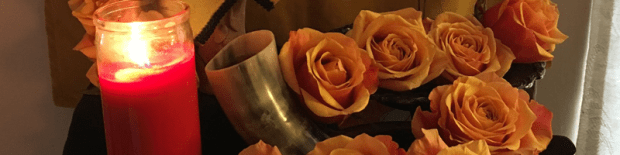
A special release especially for November, 2016 – a virtual temple for Santa Muerte, Holy Death.
Although Holy Death has no official feast day, she has a couple feast days attributed to her by believers; November 2nd is the most popular and the one I personally choose to observe for several reasons. May this video encourage prayer, contemplation, reflection, and meditation.
I’ve been planning this project for months and I’ve barely been able to restrain myself from talking all about it, everywhere. Patreon supporters at the $10+ received a sneak preview of this video releases (as well as of all future video releases). Additional videos are planned, including revisited sessions that have been seen at Pantheacon and Many Gods West. If you want to get free and early access to this material and lots more, consider becoming a supporter. Thank you very much for your continued support in this and other projects.
The video went live on the very last day of October but I’ve been so busy that it completely slipped my mind to announce it here. Please enjoy.
Loki’s Virtual Temple accounting for October 2016:
Expenses:
Flowers – $5
Incense – $5
Donations:
None
If you would like to contribute to Loki’s Virtual Temple, donations can be made to virtualtempleproject@gmail.com via PayPal. If you would like to add your name or request to the monthly prayer roll, please email the same address.
If you read my last blog post, you may have gathered that things have been rough. And they have; I’ve had a migraine most of the October and it’s only now starting to let up. It’s been a perfect storm of many health-related things but hopefully a corner has been turned. At least the migraine is starting to let up just a little bit.
What does a healthy spiritual practice look like? Well, what does a healthy life look like? There’s considerable wisdom in recognizing that a spiritual practice is not separate from the life the surrounds it; therefore the health of one is going to be indicative of the health of the other. To answer these questions we must therefore take a closer look at the idea of health.
In this context the concept of “health” or “healthy” suggests robustness, strength, the ability to withstand interruptions and unexpected circumstances. We might also extract suggestions of stability, predictability, and resilience from this particular use of “healthy”. On a further level of analysis, I’d suggest that “healthy” in this context also includes the ability to problem solve, to identify shortcomings and develop strategies for improvement; healthy is not an end point but the state in which positive, productive, and beneficial development is increasingly possible. I encompass these things and more in the prayers I make to Holy Death when I request “a quiet life”.
Some of the traditions I am part of emphasize the unpredictable nature of life and the wildly variable situations we might find ourselves in. The highs and lows are what makes incarnate life and material reality so very, very difficult to cope with but these things are also what characterize this existence; to reject it would be to also reject the many possibilities that incarnation and material reality have to offer us. They are inseparable and since unpredictability, tragedy, loss, destruction, ruination, setback, disappointment, and pain are all entirely unavoidable we must discover ways to make peace with their fact – and indeed, we must integrate them into our spiritual landscape, since there is no separation of spiritual life from every other facet of life.
There is a tendency in American paganism (and in American magical culture and in American polytheism) to equate stability, predictability, and the ability to cope with change as indications of a healthy spiritual life and a healthy life more generally. And this certainly has a justifiable logic (see above), but this logic is misapplied when the lack of these features is interpreted as a moral or magical failing. In other words, a life and spiritual practice that is hemmed in by tragedy, poverty, exploitation, illness, anger, interpersonal conflict, loss, and can’t-catch-a-break would be judged “unhealthy” or “broken”compared to a “healthy” spiritual practice. If nothing else, a “healthy” spiritual or magical practice gives you the means to express your will in the world and make the changes required to achieve increasing and continued well-being.
And it does. But.
If you look at the life story of virtually any saint or holy person you’re going to find a long list of obstacles that made spiritual life difficult for them. If a saint is closer to their god than other people, then their spiritual life must be “better” or “healthier” than that of other people – but would a saint measure up to the standard of spiritual health outlined above?
Let’s set saints aside; being exceptional people their spiritual lives were similarly exceptional and so don’t really offer a useful metric to the rest of us. We can imagine a pious friend or relative, maybe a community member. I’ll think of my paternal grandmother, a devoted Catholic woman who lit a candle to the Virgin every Friday. There was a key on her keyring that said, “I’m a Catholic; all a priest.” She explained to me once that if she was ever hurt or sick that I would need to show this to people so a priest could be called (I was quite young at the time). Her family was Mexican but they became American when the map was redrawn; they had lived in what is now New Mexico for generations before suddenly finding themselves citizens of a different country. They had been ranchers. When she was young my grandmother swept up snips of film left on the cutting room floor of the editing department of a major urban movie studio; later she became a hair dresser and worked out of the back room of her house. Her marriage was not happy; her husband and son were both alcoholics and she received no support in her faith from either of them. She died following a battle with leukemia.
It’s impossible to say if my grandmother’s spiritual life was healthy or not. Indeed, I have no idea if she herself was a happy person. She was always poor; she never had new things. I own one of the two “nice things” she ever owned, a tiny carved Madonna from Ireland. Everything in her house came from yard sales. Like countless other people in this world she lived somewhere between pennilessness and financial stability of some kind. Certainly her husband’s cancer diagnosis sent her household, her son’s household and eventually my household into precarious financial circumstances; I am still living with the repercussions of my grandparents’ material losses. What does this say about the health of my spiritual life?
This isn’t a post about the politics of poverty or generational wealth or anything like that – except it kind of is. We see fortune and misfortune in isolation, as if it is the sole achievement of individuals when in fact we often have no idea why opportunities open or close before us.
A couple years ago I was diagnosed with migraines that were considerably different than the ones I had lived with my entire life. Instead of pronounced pain and sensitivity to light and sound that would last for days, I found myself experiencing debilitating vertigo, nausea, and disorientation. I fell a couple times as a result, thankfully not badly but enough to feel intimidated at the idea of even going down the stairs. I stumbled frequently. I was scared to leave the house until I finally got answers and started to get a handle on my symptoms. Things are a little more under control these days but there are many, many factors that go into triggering a migraine attack and only some of them I can plan for. I can’t use the computer for more than a couple hours before the symptoms begin. Fluorescent lights, LEDs, high efficiency bulbs, and even strong sunlight will start the symptoms up in less than a minute. Guess how hard it’s been for me to find work that doesn’t leave me actually vomiting on other people?
Difficulty finding better work has led to a slow spiral of financial deprivation and worsening of multiple chronic health problems. I’ve found myself socially isolated, exhausted, violently depressed, and finally experiencing some of the worst symptoms I’ve had in years. All through this I’ve been wondering if these things are an indication that my spiritual life is broken, if I’ve broken my life in general because I’m a shitty person unable to make the right decisions.
And you know what? My spiritual life does need some improvement – but it needs improvement even when everything is going my way. A life that looks perfect, stable, predictable, safe, and abundant might contain all kinds of problems, including spiritual ones.
Amazingly, life resists simplicity – and so does spiritual life. The correlation between safety, stability, predictability, abundance, and all the rest of what constitutes a “healthy” life and a spiritual state in which one is aligned with their gods, surrounded by cheering ancestors, and free from curses and crossings is actually pretty weak. These things might not be entirely and completely forever unrelated but neither are they a completely predictable linked pair of cause-effect. If the gods do not reach out their hands to fix the problems besetting their most favored holy people, can we truly expect that spirituality will allow us to avoid similar complications? Besides, if having a great life was linked entirely – or even primarily! – to being spiritually awesome then there would be no atheist success stories. (Also people who demonstrate themselves to be assholes would not be successful magicians.)
The link between cultivating a spiritual life that can cope with change, adapt to variable circumstances, seek compassion, and be generally uplifting and having a life with secure material assets, dependable friends, and meaningful opportunities lies not in that one is the automatic cause of the other but in the fact that the skills by which a person can cultivate one lets them also cultivate the other. You might not choose to have a spiritual life at all – witness atheists who are happy and successful – and you might not choose to use these skills to improve yourself and your life more generally – witness the asshole magician – but you could. But even if you did you would not be free from the unpredictable character of the container that life exists inside of. Just as our spiritual life is not separate from our life more generally, so our life is not separate from the material reality that surrounds and suffuses it.
Yes, looking for the unhealthy patterns in one’s life and spiritual practice are good strategies for solving problems that tend to come up again and again. There are always ways in which we can improve these things and to some degree, the health of one will absolutely influence the health of the other. But I think the reason for this is deeper and has to do with more basic skills and self-awareness, not with any sort of supernatural transference. Do the gods bless us? Of course – but disaster does not necessarily indicate divine displeasure and this conclusion should not be at the top of the list. Does a life that is stable and secure support an optimal spiritual practice? Of course – but success in one realm does not offer a shortcut to success in another.
**
Here you might rightly wonder why, if my life has continued to have a host of material obstacles, have I persisted in my spiritual practice. Sometimes I wonder this too, because I still have some baggage that contains ideas of gods being fairytale creatures that can and will warp reality to rescue a believer from distress. They are not this way. Instead, they are companions in my distress; they remain close when I suffer. They also remain close when I succeed. My variable circumstances are not experienced alone. While I directly credit them for many of the wonderful and terrible things that have happened in my life, requiring them to author every obstacle out of existence seems like an unreasonable thing to ask. Whether they can’t or won’t doesn’t matter; they haven’t, and so I accept that reality. I ask that they help my actions have increased effects, that they lead me to greater self-knowledge, that they stay with me as I learn and persist as I do.
Even though I finally started a follow-up to Walking the Heartroad some 2 years ago (after mentally drafting it for about three years before that) it wasn’t until, um, yesterday that I finally laid hands on the files that had gotten lost in the grand computer shuffle of 2015. It’s taken me an awfully long time to come back to this project. I’ve spent the last couple years heavily focused on making the Loki and Odin devotional books, writing Worshiping Loki, handbinding the limited run of Worshiping Loki, and getting the Santa Muerte book MS started. (And also, you know, working two jobs and studying and practicing and working on projects for clients and and and.) BUT! Now that I finally have the files at home on a computer that is unlikely(?) to break down in the foreseeable future, I can finally get back to it.
If you’ve taken a look at my Patreon, you may have noticed that supporters at the $5 level receive previews of works in progress. This month supporters got to see a sample of the Santa Muerte book. In October, supports will get to see a sample of the new Heartroad manuscript. So far I have material about obstacles on the devotional path, pitfalls that devotional practitioners might encounter, and a few other subjects. While Walking the Heartroad had chapters that flowed into each other, this new book will likely be a series of essays that can be read in any order. It’s a book about the things that can happen in a devotional practice over a long period of time. While beginners are certainly encouraged to check it out, its intended audience is people who have been engaged in devotional practice for many years.
I’m actually really excited to get back to this book and I can’t wait to share it with you. This is a great time to become a Patreon supporter; I’d love to have you along for this proceses. Even if you can’t support this campaign right now, please feel free to share it with others. I’ve got loads of project plans that I’m looking forward to working on.
I sincerely hope you enjoy these temple videos and find them spiritually meaningful. They will continue to be a monthly offering to Loki and to the greater community. If you have found these videos meaningful, please feel free to share them and to tell people about Loki’s virtual temple video series and the Virtual Temple Project. You can also donate to virtualtempleproject@gmail.com. All donations go towards worshiping Loki.
A special temple video is planned for autumn. More information as that project moves forward.
Spiritual cleanliness is without doubt an important topic. For many years I borrowed the medical model to better understand and explain my experiences. I used (and still use, sometimes) terms like ‘cleanliness’, ‘contagion’, and ‘repair’. Of course, these words – and all others – are merely analogies for the processes themselves, placeholders that indicate familiarity with the principles I seek to describe. If, for instance, I do energy work in an environment I’ve prepared as ‘clean’ in order to achieve a highly controlled result, I have not actually changed anything from dirty to clean; I have simply undertaken actions that I know will help me achieve my desired outcome. The medical model is an analogy that helps me describe control, clarity, and precision in my work.
**
A couple years ago my local Thelemite body discussed spiritual purity and consecration. To paraphrase that conversation, we collectively put forward the definition that to purify something spiritually was to remove prior associations not in keeping with the desired outcomes; to consecrate was to dedicate something to a particular purpose.
“Is that what we’re trying to do?” I asked. “Become aware of the associations holding us back so we can consciously set ourselves to a new purpose?”
Purification and consecration are achieved by close examination of the assumptions, expectations, hopes, and fears inhibiting truly honest self-perception. For the magician, purity is honesty and honesty, purity.
**
In some of the paradigms informing my practice the accumulation of what-might-be-called spiritual contamination is not actually something to be terribly worried about. Becoming aware of the influences that cloud our spiritual senses is the first step towards addressing that contamination – but the contamination is not bad except insofar as it might prevent us from achieving our individual spiritual goals. Contamination only becomes a problem when you decide that it is; until that moment, it is simply accumulation.
**
I recently attended a class given by local Hellenics, people for whom I have a good deal of respect. They’ve been doing their work seriously for a long time and have chosen to share the insight of many years’ worth of practice with the greater community. In that class they led us in identifying three primary causes of miasma – which, according to people actually within the tradition that this term comes from is simply defined as ‘the spiritual byproduct of being human’. We wrote on the dry erase board DEATH, MARRIAGE, and SEX. These are three highly human concerns and in their tradition these are three concerns rather saturated with the spiritual byproducts of being human. DEATH, we determined as a group, concerned Holy Powers like Hades. MARRIAGE concerned Holy Powers like Hera. SEX concerned Holy Powers like Aphrodite.
The instructor asked, “Are these beings impure?”
“No,” the class responded.
**
There is an image of the Divine Mother that depicts Her holding a clear glass bottle along with traditional items like Her bell, sword, trident, discus, and noose. Why a glass bottle? Because it is garbage. Because when one of the innumerable demonic creatures that threaten cosmic balance started acting up, the Shining Ones came to the Mother as She emerged from a river after bathing. The demon had descended into the sewers where all pollutants go to collect and stew. Bound by the laws of the universe, the Shining Ones could not enter a place fundamentally incompatible with their nature. Moved by their pleas, She rubbed some of dirt from Her skin and manifested Her power into that speck of grime. She used dust from Her celestial body so that the new being could enter safely into that hidden place. She used Her power so that this new being would be able to act with all sacred agency no matter where the battle took place.
Some people questioned this story – how is there any part of the Mother that is impure? Others responded saying, “This is Her lila.” I personally say this story shows us that there is no place where the gods are not.
**
There is a “new” goddess – Swaccha Narayani, the broom goddess. The broom, a symbol of the very lowliest sort of chores, was elevated to a place of worship in order to make cleanliness something that everyone felt personally responsible for. No longer could it be the task of only a handful of people to clean up after everyone; cleanliness is everyone’s responsibility and Divine Mother Herself is no stranger to the broom, to filth, or to need to make improvements in the surroundings. If a sword can cut down an enemy when held in the sweet hands of a goddess, a broom can surely be used with similar effectiveness. There is no impurity in filth, for even the Mother wields the symbol of cleaning up, of getting dirty.
**
In my Shakta lineage there is a saying: “There is no impurity before the Mother.” The Mother offers unilateral mercy to drunkards, thieves, murderers, cheats, fools, saints, and you. And me. While a certain standard of behavior might be in place for the rituals that lead one to being ready to approach the Mother, even if these things are not in place the Mother still grants mercy; after all, grace is Her prerogative. Even when the standard is rigorously followed to the highest degree, the Mother might still withhold Her grace. While it is a good idea to strive for those behaviors that make ritual purification most effective – proper diet, charity, compassion, temperance, chastity, and humility – grace is the Mother’s to give. She cannot be compelled by anything – save, perhaps, our devotion.
**
There exists in some almost-forgotten corner of the Asian continent an enormous manual of ritual practices. This manual outlines in precise and exacting detail how qualified individuals prepare for worship – and only individuals who prepare can even hope to become qualified. Every waking moment is prescribed from the way to wake up, to the first direction to face, to the first words to say upon standing up for the first time each day.
Every proper sort of worship is also outlined in meticulous detail. What metal should be used to make the implements of worship? How should those materials be collected? How should those materials be prepared? Who is qualified to collect, prepare, and transform the materials required to create the required implements for worship? Those details are there. The people who prepared these rules were quite possibly the highest experts on the matter of spiritual purity. Centuries later their descendants still possess that manual and still implement its instructions. They pride themselves on holding themselves to a standard of practice more rigorous than any other line of spiritual descent. When asked directly if they still follow every rule, the only response was a sheepish non-committal gesture.
It seems that the experts determined that when the pursuit of purity got in the way of the actual doing of the work, then the actual purpose of the endeavor was lost to the minutia. In other words, at some point it was determined that one could, in fact, have too much purity.
(Here, now, we might scoff and say that well *of course* there’s such a thing as “too much” of something if you stretch an example to the point of outrageous absurdity. Except that the people compiling the manual of ritual purity and ritual worship *did not* see it that way. Their task was preparing a book that would contain answers to all possible questions regarding a topic of utmost importance to them. They wanted no ambiguity on this matter. They were not, perhaps, themselves personally concerned with overseeing the implementation of every rule they wrote down. They simply did their best to anticipate every possible question and to provide appropriate answers. Having an answer to every possible question regarding ritual purity might be valuable in a tradition that holds purity to be a matter determined nearly exclusively by behavior, not by birth or any other characteristic; however, even in the midst of striving to implement absolutely every rule at every time for every person involved in the operation of central ritual settings the line of descendants eventually had to concede that *someone* had to sweep the floor. If preparing to do ritual becomes of greater concern than the ritual itself, eventually one’s emotional focus shifts from love of the gods to love of achieving perfection via following rules. Admittedly, this probably something that very few of us have to worry about and indeed, adopting a purity practice had a profoundly positive impact on my spiritual life – but if you talk with enough Ceremonial Magicians you’ll discover that this problem is alive and well today.)
**
My personal purity practice began formally about five years ago. Even though I’d been following ideal diet and dress habits for many years prior to that and attempting to grow into purer mental and emotional spaces (attitudes of humble service, charity, compassion, tolerance, and forbearance being essential parts of these efforts), none of these were taken up with an eye towards purity practices. Indeed, since I had always been taught that there was no impurity before the Mother I rather thought that I didn’t have to worry about these rules and standards. I was wrong. It is intensely wrong to dismiss out of hand something that you actually don’t understand anything about. I knew nothing about ritual purity; I was extremely arrogant to assume that it had nothing to teach me
Over weeks and months and years I very gradually started to acquire better ritual hygiene. And I don’t just mean energetic/spiritual hygiene in front of the altar or in ritual or in magical practice – though these are kind of the intended outcomes of such habits. My worldview shifted profoundly, yet subtly. I saw things differently and I understood things differently. The practice taught me, as all good practices should.
I’ll be the first to admit that I know nothing. Five years is not enough time to become even mildly fluent in the school of purification I was studying. A lifetime might not be enough. I imagine all practitioners eventually realize in a very personal way that there will never be enough. The elusive ingredient (heh) is divine mercy. This is why we confess our errors; this is why we ask forgiveness; this is why we seek shelter. Mercy must come from another place, from a source that can deploy a power that drowns our errors and imperfections. Even purity, I discovered, is impure. Even purity requires humbly asking our guides, gods, and Powers for grace – for presence freely given.
**
The title of this post comes from one of my very favorite videos of my very favorite video makers. Watch. Love.
After considerable waffling and lots of prodding encouragement from friends and fans, I’ve created a Patreon for my books, articles, lectures, and other projects. Money and time have become my biggest obstacles to finishing long-standing projects like the follow-up to Walking the Heartroad, a forthcoming book on Holy Death, and audio book versions of Worshiping Loki and other materials. Simply earning a living occupies most of my time and leaves me with very little energy or creative capacity for working on the things that I – and you! – love most.
Patreon offers me a partial solution to this problem. Simply put, the more money I receive through the generosity of patrons, the more time I can afford to put towards completing these and many other projects. I have loads of things I want to do:
Narrated videos of sessions presented at PantheaCon, Many Gods West, and other conferences (including recent material like Advancing Devotional Practice and Three Tales of Apotheosis)
Video lectures and lessons of material that will probably never be presented at any conference
Audio book versions of Walking the Heartroad, Worshiping Loki, and other books
Prayer cards for Loki, Santa Muerte, and other Powers
Books and articles on devotional practice, altar building, and more
Do these sound like projects you would like to have available? Even one dollar will help give me the time required to complete these and many others. Please feel free to share my Patreon link on your own blog, Facebook, or Tumblr; boosting the signal is a great way to support this campaign even if you cannot give monetarily right now. You can also ‘like’ my official Facebook page where I’ll post updates about all kinds of things I’m up to.
In thanks for my patrons’ support I have a selection of perks including generous coupon codes, previews of work in progress, copies of books as they are published, and more. The first sneak preview will be going out next week!
This is a very new way of creative labor and I’ll be honest, it took most of a year for me to work up the courage and confidence to make this happen. I’m excited to take this decisive step towards improved creative and artistic production and I’m grateful for everyone’s support thus far. Together I know we can bring exciting and meaningful work to pagan and polytheist communities.
Thank you for the many years of support you’ve shown my work. I can’t wait to see what comes next.
Filming Loki’s temple video was delayed a bit while I prepped for Many Gods West. I’ve returned and resumed filming. I brought back many very valuable ideas from Yeshe Rabbit’s session on building temples and will soon be integrating these ideas into Loki’s Virtual Temple and probably into the Virtual Temple Project as a whole.
In the meantime, please enjoy this month’s visit to Loki’s virtual temple.
Financial report for August:
Flowers: $6
Incense: $5
Beverage offering (tea) $2
Donations $0
Thank you for continuing to view these temple videos; I sincerely hope that they provide spiritual comfort and connection with Loki, and an opportunity for reflection, prayer, and contemplation. As always, if you would like your name or a concern added to the monthly prayer roll, simple email virtualtempleproject at gmail dot com. This is a free service offered to the community. If you find this project valuable, a donation of just $1 will help support it. Donations can be made through Paypal using virtualtempleproject at gmail dot com or just click the yellow Donate button at the top of the page.
I typically define devotion (in the religious sense) as ’emotionally-engaged religiosity’ or ‘a form of religious engagement that prioritizes emotional experience’. To my mind, that’s really all it is in a broad sense. Naturally, each tradition is likely to discuss devotional matters in different ways; some are highly emotive and seek to refine the emotional experience to greater and greater heights while other traditions dedicate the lion’s share of their discussions regarding engagement to things like scripture study and prayer. Today, here and now in 2016, the people reading this blog are likely to place activities like scripture study and prayer into the category of ‘devotional activities’ because these things can be both an expression of the religious emotions we feel and the religious emotions we hope to feel.
I am delighted and thrilled that the category of devotional engagement is opening up because 10+ years ago the idea of clarifying pagan- or polytheist-specific devotional practices was met with an awful lot of blank stares. Sure, there were people doing some amazing work – there were people tending the flame for Brighid in the late 90s and probably long before that, there were some prayer books, and some teachers I knew had identified a dozen or more devotional practices relevant to solitary pagans – but the level of discussion was nowhere near what it is today.
I say this because we have to remember that the practices of pagans, polytheists, witches, and others functioned coherently and delivered profound spiritual satisfaction *even in the absence of articulated devotional practices or ideas*. We didn’t need to know that we were – or weren’t! – “doing” devotion in order to get deep pleasure and enormous benefits from our various spiritual practices. We heard the gods. We spoke with the spirits. We danced with the Powers and blended our lives together in revolutionary ways.
The “doing” of devotion has not changed. We’re still all doing very much the same things, if only because there are sets of tools that consistently work more or less regardless of context or applied meaning.
The “talking” of devotion has changed considerably. The words we use, the things we say, and the ways in which we say them are very, very different. Against the way internal dialogues of paganism and polytheism five, ten, fifteen, and even twenty years ago we here today in 2016 might as well be speaking a different language. I know because I was there and I remember.
The “thinking” of devotion has also changed. While I’m generally inclined to say that anything that pushes the thinking, talking, and doing of devotion into new territory is ultimately good, growing up is not easy.
In my own devotional maturation I’ve chosen to spend a lot of time around my practical elders – in particular people coming from highly articulated religious and devotional practices going back hundreds, and in some cases thousands, of years. Some of these experts are people for whom emotional engagement is the only meaningful language of spirituality. All other forms of engaging with and relating to the Holy Powers are subsumed by the endless tide of sentiment. They take their devotion very seriously and so I have gone to them for instruction.
They have very helpfully pointed out – on more than one occasion – that devotion is not easily approached when one is hungry, fearful, injured, in pain, grieving, angry, or depressed. One cannot focus on cultivating sacred relationship or even on simply associating with sacred spaces when you are worried for your life, the lives of your family members, and the lives of people who look like you. “Devotion is hard,” they say, “when you’re hungry.” Devotion is hard, they say, and they know that devotion is the very simplest and easiest form of sacred relationship.
If one cares about devotion, about the “doing” of devotion in particular, then one must also care about removing the impediments to that doing.
Even as I fall to the ground in front of the sacred spaces I have spent years carefully preparing and beg for assistance meeting my physical needs, I know that not everyone has the freedom or safety to do the same.
Can one discover the gods under duress? Of course. But perhaps there are easier ways.
To be clear, I care about the pursuit of justice, equity, resolution, and reconciliation because I find these things to be intrinsically valuable for their own sake. Striving for equity and reconciliation is a way of honoring the intrinsic dignity of every soul, of securing the freedom of sentient beings to pursue their own ends without being restrained by needless suffering and conflict. In other words, the material world can really suck but an awful lot of that suckage is due to people being shitty to one another. Whether individual or systematic, oppression creates suffering that doesn’t actually need to be there. When suffering is compounded by years and by generations, how can we reasonably expect someone to dedicate valuable mental real estate to the “proper” ways to pray, build an altar, or worship? Moreover, what kind of spiritual violence would I be enacting if I degraded someone’s choice of spiritual refuge from this kind of suffering? What do I know about their struggles? What do I know about their pain? What do I know about the relief that they seek in the arms of their own particular spiritual Beloved(s)?
If I was angry at people for seeking relief from the pain of existence in a monotheist paradigm, I would be as harmful as the people who are angry at me for seeking relief and spiritual shelter in a polytheist paradigm. I’m not willing to perpetuate that kind of unnecessary ideological or spiritual violence.
There are an awful lot of people in this world who would tell me that my life would be better if I just turned to Jesus. There are an awful lot of people in this world who would tell me that my my life be better if I just turned to the Gods. Neither of these hypothetical groups of people actually understand the nature of my suffering or the ways in which I seek to relieve it through communion sweet. If you wish me to take your spiritual counsel seriously, seek first to remove the burden of unnecessary suffering from my life. Seek to help me access medical care that I can afford. Seek to raise wages to a living level. Seek to secure safe housing. You see, these are the obstacles to my devotion. If you care about devotion – about my devotion, in this scenario – then you must also care about the things that prevent my desired engagement.
In an ideal world we perhaps would not have to chose between, say, beautiful altars to our beloved Powers and a bedroom for a roommate who will split the monthly rent. Perhaps there are people for whom money is no object, employment a secure pattern, and good health a lasting guarantee. Perhaps these are the people most likely to scoff at the idea of balancing outwardly-visible signs of devotional engagement with the need to simply live.
I will not tell someone engaged in the fight against militarized police, against worker exploitation, against the institutionalized murder of poor people through the withholding of life-saving medical treatment that their priorities are wrong. I won’t tell them they’re wrong because first of all, I’m trying actively on a daily basis to be a decent human being. Second, I would never tell them they’re wrong because *it’s absurdly obvious to me* that the very forces they’re struggling against are the forces keeping them from devotional practice, spiritual engagement, and simply being alive.
Caring about social justice, about the pursuit for equity, for resolution, for peace,and for compassion is *not* an either/or proposition in relation to a devotional practice. Caring about social justice is the way that any of us may finally secure the kind of spiritual life we wish to lead.
The gods are made immediately present in this world through the hearts, actions, words, and bodies of their devotees. In a devotional paradigm, this single truth is the reason why the company of believers is so ardently sought and the reason why so many traditions emphasize the provision of service to one’s religious fellows. We might therefore regard the loss of a single believer as the loss of something beloved by our Beloveds, as the loss of a unique and irreproducible window into the divine world. What does stating that someone ought to focus more on the gods and less on the struggle for livelihood, health, and familial security actually mean? Does it mean that we disapprove of someone’s religious priorities? Does it mean that we don’t take their struggles seriously? Does it mean that we respect their contributions to the body religious more than their inherent needs as an embodied being – and if so, are we comfortable with the fact that not addressing people’s inherent needs as embodied beings *directly* reduces their capacity to participate in religious activities even as we criticize them for lack of participation?
Do you see the cruelty contained within these conclusions? You might come to the same conclusion I have: that holding such opinions means that the spiritual activities and contributions of some people are more valued than others. That is, if I am unwilling to take seriously the struggles of my fellow believers and if that lack of consideration leads me to criticize their lack of involvement in our shared faith, then I don’t actually care about my fellow believers as human beings. If, on the other hand, I truly see the gods reflected in their eyes then I know that any impediment that prevents them from living freely, loving deeply, and growing to their full potential as embodied spiritual beings then I must make their priorities my own – else I have failed to care for the very body of gods.
Once again, I want to emphasize that caring about the many facets of what we currently call social justice is a reasonable conclusion if one acknowledges the inherent dignity and the right to the means of existence common to every sentient being. I simply wish to put forward a defense of this stance framed in a devotional paradigm. I’m tired of seeing the devotional paradigm only used to criticize the pursuit of equality and justice. Frankly, I don’t think that that’s really what devotion is for (see my personal definitions up at the very top). By the same token, I don’t really think that a devotional framing is necessarily the right refutation either – but it needed said nonetheless.
I wanted to write just a bit about Many Gods West before the experience got away from me.
To start with, I had an excellent time. In many ways it was the most comfortable and enjoyable con experience I’ve yet had. A big part of this was having all my migraine meds. Last year I didn’t know what was going on with me and I was very nearly incapacitated by pain, nausea, and disorientation that whole weekend. (If I spoke with you in 2015 and then couldn’t remember you, or if you came to my session and wondered why I couldn’t make my eyes focus or speak clearly – I was suffering serious neurological symptoms and couldn’t fix it.) This year I had my special pink glasses and a whole pharmacy – and still suffered quite a bit but overall had a much better time. Physical aches and pains were also lessened; I only needed my cane one day!
The hotel was very comfortable and the scenery was stunning. I spent a lot of time on my balcony just staring at the trees and the water and Mt. Rainier on the horizon. I can’t tell you what being near so much water does to my spirit. The best image I can reach for is those time-lapse sequences in nature documentaries where desert plants swell into life and burst open for a few short hours before crawling back underneath the dust. I’ve lived in the desert my entire life and I forget – literally forget – that there is so much water in the world, that there are vast, deep, cold sounds full of slate-dark water and that cold winds blow when the tides shift. I forget these things and when confronted with them I couldn’t stop the tears.
I got to have many interesting and exciting conversations with people. As fun as programming is to attend, in many ways its the chance to network and share ideas that is most appealing to me about conferences and conventions – and this from an introvert. I came away with lots to think about, both in terms of advancing projects that are deeply meaningful to me and improving myself and my practice.
Being around new people in new circumstances is an opportunity to see oneself in new light. I discovered that I have not nipped my gossipy nature quite as close as I thought; I still have a tendency to bring up very old hurts and injuries and stories. Even as I try to curb my words I just can’t give up the desire to jump in; the desire not to be left out (or the fear of missing out) is a big personal obstacle of mine and I got to see the ways in which I still have to improve in this regard. In some cases I found myself later regretting something I had said or implied or suggested; these instances were thankfully relatively minor but I still have much I want to improve. I also need to be a whole lot better about not talking over people, about not interrupting, about not rushing on with what I think I have to say instead of giving others the space they need to shape their own words. I apologize for taking up more verbal space than necessary. I’m deeply grateful that so many people chose to share themselves with me and I will strive to improve the way I communicate.
I may have said something that hurt or stung or dismissed you. I sincerely apologize and I want you to know that I am having some long hot baths with myself to identify my shortcomings. I am making concerted, active efforts to improve. If there was a hurt I caused, I recognize that I may not be able to correct it – not here, not now, not ever. I honor you as my teacher on the road to deeper self-knowledge and self-improvement. Please accept my apology and know that I will carry improved behavior forward in order to minimize the suffering of others and prioritize compassion individually and throughout the worlds.
Something that I learned – or rather, relearned – is also worth mentioning. See, I agonize over “not fitting” a little more than I actually need to. I worry about not fitting into a tradition, about not knowing what my tradition is, about not feeling confident that I can claim one tradition or another when I don’t fit into it very well, etc. etc. etc. And you know what? There are LOADS of other people who share exactly the same thoughts and feelings. There are lots of of other people who don’t know what to call their tradition or even how to describe their practice. They aren’t sure what label to claim because they’re not always sure that a convenient label is better than an accurate one – and finding an accurate one seems impossible. I often don’t know how to describe my polytheism, my practice, or my affiliations with traditions. I’m not alone in this and oh, that makes me feel good.
I had the chance to be confronted with information that I never knew or guessed at. I had the chance to make a decision about how I would react this information. I had the chance to feel my heart opening. I had the chance to clarify my boundaries and oh, I had the chance to see those boundaries respected. Thank you, thank you, thank you everyone for understanding that I have limitations due to physical problems. Even when people don’t personally experience the same kind of disabilities I do, absolutely everyone I told about my limitations *took at face value* what I told them. This is not something that I have always experienced; invisible disabilities or disabling conditions that are not always in full force are sometimes hard for others to understand. I received nothing but honest acceptance and compassion. Thank you.
I came away from the event with a clearer picture of the many ways in which I need to grow and improve as a (human) being in a community of other (human) beings.
 The Road, the Walker, and What Comes Next