Seeking Together (Pagan Experience Project March wk3)

Though this week’s original prompt, “What do you seek from the divine?” has been switched to a prompt about the types of relationships shared with the divine, I’m actually choosing to write about the first one. I’m doing this because I think being honest about our motivations within relationship, whatever configuration that relationship might be, is part of what helps that relationship develop in a healthy and productive manner.

While I don’t necessarily subscribe to the magico-religious theory that holds a specific action or petition is going to have an automatic result simply for having asked (aka, the cosmic vending machine theory), I am a fairly ends-oriented practitioner in many regards. That is, various religious and magical practices are engaged in with a particular desire in mind. These practices are chosen, in part, because they seem to offer what I hope to achieve and because the process seems compatible with my magical skill, my style of practice, the web of commitments I’m part of, and so forth. It’s the second part that sometimes gets left out in ends-oriented planning.

There’s the cliché story about the teen girl who wants to do a love spell and so heads off to the local witch shop with a shopping list culled from a love spell printed in a book. The proprietor suggests simply making an apple pie instead since all the same ingredients are used (and when I tell the story, I like to add that even if the protagonist is rejected, she still has consolation pie). The girl throws up her hands – that’s too much work! Baking is hard! Can’t I just do a spell for love instead? Yes, this story is a cliché and yes this actually does happen from time to time (witch shop proprietors can certainly tell you a few stories), but there’s more than one lesson to take away from this. First, of course, is the lesson that magick is work and takes effort and skill, just like baking a pie.

The second lesson in this story is about choosing between two paths that lead (ostensibly) to the same outcome. The teenager in the story might be quite terrible at baking and so knows that her efforts are likely to fail and alienate the object of her affection. The teen might also have also engaged in some personal magickal practice and already has a little skill built up. The point is that you have to choose the processes that are most compatible with your skills, aptitudes, experiences, and so forth.

Of course, if I were in this situation, I’d do both. I’d make a love pie and do a love spell. There’s nothing wrong with addressing a problem with multiple strategies to best leverage their respective advantages. This is why I meditate *and* cultivate a consciously more compassionate mindset. This is why I live quietly *and* petition Santa Muerte for a peaceful life. And you know what? The Powers are much more willing to lend a hand if you’re actually making an effort on your own. You will find that their blessings flow more freely and obviously when you make an accounting of what you’re going to do with those blessings.

Like some other magicians, I was never very good at money magick. I could magick up an extra $20 now and then but my success was sporadic and not really dependable. Then a while back I hit on the idea of actually saying what I wanted the money for. What exactly am I doing with the prosperity I’m asking to receive? What are my precise monetary goals? Once I started included this information in my petitions, the magick started working better. I still struggle financially and I’m frequently on a real knife edge of need but when the money flows, it flows – and it flows from me to many other ends that help further the Powers’ presence in this world.

Ultimately I guess I seek a partnership with the Divine that helps me become a better person. I seek to be more capable of helping others and serving the world because thereby do I serve Them. If they are present, here, now, in this world (and they are!), then expanding my efforts towards improving and serving this world is going to help Them. And it does.

But past that ultimate desire is something else, an arching vault of emotional resonance that keeps pulling me up and up. Relationship is not outcome. Relationship is not ends-oriented. Relationship is process, experience, the present moment. Losing sight of that is losing sight of the real power of sacred relationship. Relationship should not be forced into a value-oriented paradigm; we should not have to prove our emotional priorities by holding up the outcomes of our divine relationships. Once again: we should not have to prove our emotional priorities by holding up the outcomes of our divine relationships.

Sometimes – not frequently, but occasionally – there’s an effort in greater pagan and polytheist dialogue to make devotional relationship mean something. And this is fine because devotional relationships can and do have very positive outcomes – but that’s not really the point. It is, however, a place to start. Srila Prapupada replied to a question about the appropriateness of praying to Krishna for money by replying that any prayer was good prayer (I summarize; I can’t recall the precise quote. I believe it’s from a little book called Perfect Answers to Perfect Questions).

Faith is not necessarily automatic. We don’t generally offer our whole hearts to the divine without some indication that they’re there and that they are responsive to us. (There are of, course, major exceptions to this but we’ll set those aside for a moment.) This happens through an exchange of attention, gifts, and so forth. We seek their attention and blessing, which is recognized as evidence of their love and affection. We celebrate their power and presence, which in turn helps endear us to them. Eventually this exchange of energy (rather nicely typified by the rune Gebo) is less about any possible future outcome and more about a present saturated by sharing.

A relationship with the Gods generally begins with desire. We seek something – proximity, affection, refined awareness, knowledge, aid in magick, or the satisfaction of curiosity. Being honest about the fact of desire and trying to identify precisely what is desired is a good thing, a very good thing. Many of Them desire something of us – proximity, affection, refined awareness, knowledge, aid in magick, or the satisfaction of curiosity. Relationship helps achieve these and many, many other desired outcomes. But sooner or later, at some point, all parties of the relationship are participating in something much, much more.

http://thepaganexperience.com

Why We Need Love Goddesses

I’ve said plenty of times that the deities in my life are all chaos and death. Chaos n death, that’s the pattern.  It’s not a matter of me being especially chaotic or deadly, but something about the way I fit into the giant clockwork jigsaw of the universe makes me especially compatible with these Powers. We fit well together. It’s always been chaos n death.

Many polytheist and pagan types find themselves aligned with Powers that share very similar domains or characteristics. A person might find themselves surrounded by liminal characters, lots of gatekeepers and crossroads types; another might find frequent allies in watery deities, deities related to animals, or deities concerned with health and healing. And of course, some people find themselves surrounded by Love Goddesses(TM).

I never “got” love goddesses. (And yes, I know there are male-type Powers associated with love and the broad category of concerns that love goddesses are also concerned with, but this actually isn’t important to the point I’m going to be eventually making.) I didn’t understand these love emotions or the beauty, art, or luxury that typically went along with love. I knew it was important, I just didn’t understand it on a personal level. I didn’t see how these things related to me.

A lot of this was very likely because I had a rock-bottom opinion of myself. I have always thought of myself as a fundamentally unloveable person – despite any evidence to the contrary. Not that I wasn’t worthy of love; I just felt that at some point, eventually, without a doubt, the people who loved me would discover that underneath the good stuff was a whole lot of garbage that wasn’t worth the effort. I have done considerable work on this front but it is still a mental stumbling block that needs constantly negotiated.

I also didn’t like myself. I thought I was ugly. I thought I was unattractive. I thought that I was repellent to others. I thought that luxury and pleasure were a waste, that they were a pacifying comfort against the reality of entropy and pain. I thought beauty was a waste because everything crumbles to dust sooner or later. Freya-norse-mythology-21934274-300-427

Freya was the first Power to step in and start to change all this. She was my first ally, in a way. She was the first Power to just up and offer to help when I was struggling with the emerging realities of life as a spirit worker and maturing devotionalist. To my mind, She had nothing to gain from this. Her compassion went straight down into me and rattled my emotional basement like nothing else had. I started to understand, very vaguely, that love was beauty and that beauty was healing.

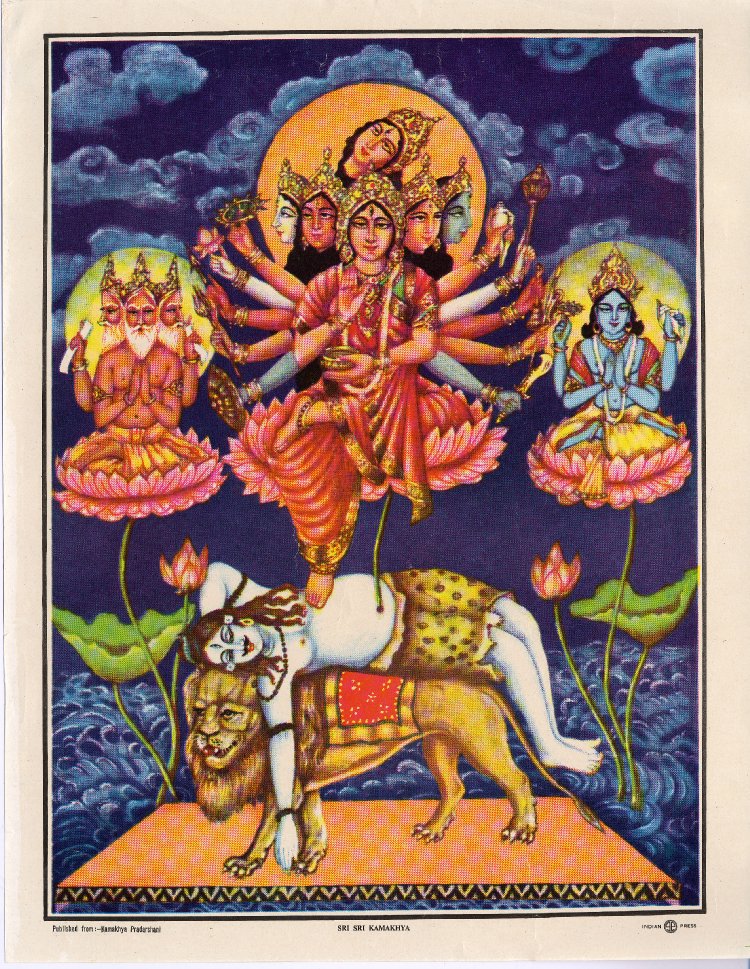
A couple years ago I came across a Power that shook me right down to the emotional basement all over again. At the time I had resumed some very old work with Kali (like, stuff that I had started when I was 16) and was feeling it struggle to resolve. It wasn’t the wrong work, but it wasn’t quite right on some level, either. I persisted, hoping it would level out. I was puzzling over a very direct encounter of Her in an unfamiliar form. I fell into the research rabbit hole and came out the other side staring into the eyes of Kamakhya.

Shakta theology and philosophy is distinctive in the context of subcontinent religious traditions and global religious traditions. Encountering a radically different form of Kali was not actually a problem in the way such a thing might be in a different tradition or context. It was merely unexpected. That Kamakhya was identified with the yoni Shakti pitha, with Sri Lalita, with Tripura Sundari, and with the very Earth Herself was more surprising.

Sri Lalita

Sri Lalita

Sri Lalita had fascinated me for a long time but I hadn’t really done much about it (chaos n death, remember? I was busy). In her hands She holds a noose and goad, two minuscule instruments capable of exerting force wildly disproportionate to their size; a goad is intended to move an elephant. One instrument propels while the other restrains. Her other two hands hold arrows made of flowers (or flowers used as arrows) and a bow made of sugarcane (or a stalk of sugarcane used as a bow). The sugarcane bow is said to be strung with a string of beads. Imagine!


I called this goddess of plenitude forms Sri Lalita Tripura Sundari Sodashi Kamakhya – because She was. She was all these things and all these things are the same entity (you know, more or less. That’s just how Shakta theology works). Through Her divine grace I learned about love. I learned about just how powerful love actually is and how it can accomplish things that other emotions simply cannot. Her grace accompanied me at every step as I dove deep back into the bhakti current that had nurtured me so long ago.  No longer content with redigesting the lessons I had absorbed as a teenager, I set about trying to learn the deeper truths of this path and She helped me gain a fuller understanding of the power of devotional practice. And this is finally the point I want to make.

Devotionalists need Love Goddesses(TM). We need the Powers associated with love, beauty, joy, compassion, and companionship. We need to have these things in our lives because our path is completely saturated in a very particular sort of love. Petitioning a beloved Power who’s already on our side *because they have chosen love and power and beauty and compassion as their domain* is one of the most effective and profound things you could ever do on this path.

Devotionalists need Love Deities. We are already in Their precious and sacred domain. They already care about us. They already love our relationships. They already love our love.

My work with Sri Kamakhya is done – at least, this stage of it is. I was going to gently put away Her blessed altar because there is another Power that I am resuming work with and I have used up the very last bit of available horizontal space currently accessible. My little heart broke. My cold nasty cynical Lokean heart just broke. My beautiful, compassionate, luminous Goddess – how could I remove her visage?

And there it was – permission. Permission to keep the altar in place, permission given by a Power who has no sentimentality, but who does have compassion. Even She has to acknowledge the most blessed patron of my spiritual love.

We need Love Deities, you guys. We already have them.

Coming to Compassion (Pagan Experience Project Feb. week 4; C is for…)

If you had told me many years ago that compassion would become a central part of my religious life, I might not have believed you. This was not a concept strongly present in any of the traditions that provided a foundation for my spiritual life; nor was it really central to any of the traditions I found myself exploring as my spiritual life unfolded.

I came to compassion like many other people do – as a direct result of profound personal suffering. This is perhaps the first thing to understand about compassion; it’s not a concept that others can tell you is valuable. You have to come to this realization on your own, through direct experience of the constellate emotions that reveal its boundary.

My spiritual life has been endlessly rich and possessed of intense, profound value. It has also been the source of a degree of suffering I didn’t imagine myself capable of enduring. Experiencing those heartbreaking depths was arguably necessary for growth but the months and years of saturated distress broke me. I very gradually came to understand – really understand – that I wasn’t alone in this suffering. What I was feeling wasn’t actually unique. It was personal, but it wasn’t unique to me. Everyone on earth, all sensate beings incarnate or not, also suffered with a pain and distress as deep and immediate as my own. The causes of their suffering might be known or unknown to me, might appear to me to be greater or lesser in effect than the causes of my own experience, but these things weren’t actually that important. What was important in that moment was the realization that I was not alone. Neither, for that matter, was anyone else.

This realization has unfolded to include many nuances and further realizations. For instance, my empathy and compassion are not dependent on my intellectual understanding of another’s distress; nor should they be. Knowing that my own distress and any resultant traumas are real is enough; after all, I am not alone in these experiences. Valuating the relative impact of another person’s experience of distress and suffering is also unimportant. These subjective experiences are difficult (or impossible) to objectively measure. No tick on a number line should determine how much I care. Though I am limited in material resources and in terms of personal resilience, and though I’m also limited by whether or not another person needs, desires, or even wants action motivated by compassion, none of these things diminish the reality we all experience.

I am not very literate in the subject of compassion and nor have I studied its philosophies very deeply. I’ve relied on my personal experiences and my observations to teach me what I need to know though eventually I need to delve a little deeper into the subject because I can’t always come up with answers on my own. There are questions I have that I might someday be able to figure out but masters and teachers and guides exist for a reason.

Though I strongly believe in the value of compassion and have found it to be of great practical use, I do still struggle with it. There are many circumstances when it seems like it simply doesn’t make any difference or that my mental and emotional energy would be better spent by getting angry or going on the offensive. Sometimes I feel like “having compassion” is used as a mask for bland platitudes and meaningless sentiment. Sometimes being told that someone has compassion for me is cruel. “Do you?” I feel like asking, “Do you really suffer with me in this matter? Or are you simply trying to tell me that you pity me, that you feel sorry for me, that you believe I deserve to feel anguish because of the choices I’ve made?” Compassion is not a simple subject and its expressions are immense and complex.

I find myself wary and weary of the rhetoric of violence. This is only one possible frame for categorical tensions, whether these tensions exist between the groups people align themselves with or between other axes of alignment. This might be strange coming from someone with a Heathen bent. I did after all spend a number of  years trying to fit into that community, I worship Gods who come from that context, and it is the tradition (rather broadly speaking) that taught me my spirit work. It’s also a tradition rather known for celebrating the trappings of violent conflict. Though I understand that these things are frequently celebrated in a historical context – modern Heathens celebrate the bravery and valor of our personal and collective ancestors – perhaps other parts of this tradition’s historic heritage are also worthy of celebration. It’s possible to be known as a tradition of explorers, artists, farmers, and yes, even householders. These are things best served by diplomacy, negotiation, and conflict resolution.

Arriving at a point where I value and celebrate compassion by no means indicates that I’m “good” at it. I’m not. I’m repeatedly forced to confront the trauma I’ve endured reflected back in the experiences of others. I respond by withdrawing and internalizing my pain. I hold this value close to my heart and will still choose actions that lack its mediating influence. I’m still mean, I still choose the lower road, I still take actions that I’d counsel others not to take. I still step into the sphere of others’ emotional lives and feel offense on their behalf; this leads me to dislike and mistrust others when I have no personal reason for doing so and the result is the loss of a compassionate stance.

I am heartened that I have endless opportunities to practice compassion in all its manifold expressions. This, like many other things in my life, is a sadhana, a spiritual practice undertaken for the refinement of the self in this and other worlds. Sadhana pares down the bullshit through discipline and reveals its strength with repeated application. Compassion is a powerful force and it drives an evolution that is reshaping me to the very core.

http://thepaganexperience.com

My Life’s Top Priority

Almost fifteen years ago I gave oaths of loyalty, service, and affection to My Lord. This undertaking had more steps than I anticipated. When I first decided, “Yes, this is something I’m going to do”, He stopped me. My heart wasn’t in the right place. My motivation wasn’t right.

But isn’t this right? I asked. This is what you wanted from me. I’m just doing what you asked me to.

That was the problem and that was my very first lesson.

Continue reading

Powers in my life: Saint Death (Pagan Experience Project Feb week 3)

santamuertaLooking back over my blog I’m noticing a very heavy emphasis on the Hindu side of things, which might suggest that this is a dominant force in my religious life. It’s actually not, at least not on a day to day basis. There are some devotions and observances I maintain and I’ll eventually get to those but at most I regard myself as a student of this collection of traditions, not as a member or participant.

I’ll start by talking about the Power in my life with the most controversy. Interestingly enough, that Power is not Loki.

Continue reading

A is for Absence (Pagan Experience Project week 4)

I haven’t given up on the Pagan Experience Project. I thought perhaps I would but I’ve been thinking about that A/B prompt for, uh, two weeks now and figured if I can’t shake the curiosity over the project then perhaps its worth continuing. It also took me two weeks to decide what to write about.

Radha Alone by Shyamarani Dasi. More information and purchase options here: http://bhaktiart.net/hp_wordpress/?dt_portfolio=radha-alone

Radha Alone by Shyamarani Dasi. More information and purchase options here: http://bhaktiart.net/hp_wordpress/?dt_portfolio=radha-alone

Absence is definitely one of the most challenging feature of a life lived close to the gods and a frequent companion of people seeking Their attention. Typically, absence is an experience we seek to overcome; it’s an obstacle to the state of sacred communion that the devotee seeks to return to. Often, the experience of absence is taken as an indication that there’s something wrong. The practitioner’s affection is lacking, the practitioner has failed to fulfill some task that would bring on the feeling of connection, the practitioner is unworthy to experience the presence of the Divine, or the practitioner has failed to captivate the Beloved quite as much as the Beloved has captivated them. Absence is regarded as the indication that something is wrong and that the practitioner has failed in some way.

I’ve experienced lots of absences in my spiritual life and those vacant months piled up as evidence of my failure. Nothing in life had changed but there was no illuminating quality to anything. Though I later learned the regard absence as the opportunity to learn a kind of spiritual self-reliance, even after identifying a valuable outcome from the experience it wasn’t easy or pleasant. These absences taught me to inhabit a space of radical solitude. This solitude is not loneliness or isolation, it is a deep, deep comfort with one’s own company. Absence taught me to be OK with the sound of my own thoughts and the resonances of my own spirit. Absence taught me the sound of my own ego.

(To cast self-reliance as some kind of rugged individualism that resists the throughput of material, social, emotional, and mental support from other people and the systems we have built is short-sighted and rather unnecessarily isolationist. Spiritual self-reliance, to me, is not the fulfillment of one’s spiritual needs through one’s own efforts. It is instead the reliance upon – and requisite trust in – one’s spiritual self, including intuition, magickal ability, and esoteric skill. This reliance results as knowledge of the spiritual self is gained. This includes the recognition of one’s own egoic voice and desires. Ideally, this spiritual self-reliance is weighed against the guidance of the Powers and negotiation on equal footing can begin.)

Quite recently I came across a little passage of text that suggested that absence has a different and more esoteric dimension.

In Blue Lotuses Everywhere: Divine Love in Gaudiya Vaisnava and Catholic Mysticism (in Gaudiya Vaishnavism and ISKCon: An Anthology of Scholarly Perspectives ed. S J Rosen), author June McDaniel writes:

These states of separation and union in Catholic mysticism are associated with the sates of purgation and illumination, which lead towards the ultimate union of love. In this state of purgation, the devotee is without God, and life is dry and arid. […] For St. John of the Cross, the purgative period included both the dark night of the senses, and the dark night of the spirit. In the night of the senses, there is darkness, pain, a lack of joy or enthusiasm. It is a crisis of the senses which is given by God to develop a higher kind of love. […]  Purgation leads to the development of the internal senses (especially imagination and memory) and encourages the transformation of sensual love into spiritual love, and natural into supernatural.

Emphasis mine. Emphasis possibly yours, too.

This assertion is accompanied by relevant selections from the Catholic context and then paralleled, contrasted, and augmented with information about the development of the spiritual body within a Gaudiya Vaishnava context. Though interesting, the topic wanders a bit from A is for Absence and more into B is for Body, Spiritual; a worthy topic but one for another day.

Basically, what we can take from this perspective is that absence can play a very important role in spiritual development, specifically in the transformation of our emotional nature into an aspect of self potently accessible to the divine. This spiritual emotional nature thereby becomes the interface that allows for more nuanced expressions of relationship and all the manifestations that emanate from those feelings.

Radha-Rani sanjayThis transformation can be characterized with the help of the solve et coagula formula if you’re so inclined; something emerges once something is pulled apart. It can be framed in the formula or rot and resurrection. It can be framed as refinement and the shedding of dross. It can be framed as the dedication of aspects of the self to a higher service. It can be framed as an alignment with the spirit world and the creation of the self as a conduit for Their manifestation. There are lots of ways to think about it. But perhaps these things aren’t super important to you right now.

Perhaps right now it’s more important to sit with the idea that the absence you’re experiencing isn’t indicative of your failure or or shortcomings or flawed character. Maybe the idea that this experience is a positive one will transform these days into something more refined, as well.

http://thepaganexperience.com

Petition As Magic; Petition Is Magic

In my mind, I’ve had this rather clear distinction between prayer and magic. Prayer is a private conversation between you and a Power. That conversation might be celebrating that Power, thanking them, praising them, asking for their assistance, expressing your fears and concerns, or just touching in. It’s characterized by communication.

Magic, specifically spell work, is also expressive but less nebulous in its purpose. Magic (spell work) is intended to get shit done. Instead of talking to someone, you go out and take care of business. The spell worker draws upon personal skill, the ability to move energy around, and a high degree of problem solving ability in order to bring about their desired outcome. Though there are instances when spells and prayers might be very similar in form, in my mind these two things work best when they’re fairly distinct. To me, calling spell work “just another word for praying” was rather missing the point of both activities, but to each their own.

Recently though I’ve been rolling around a new perspective on both these activities. The ability to get your ideas across, to communicate clearly and meaningfully with the Powers, and the confidence that help will be forthcoming are all important parts of prayer. Praying is in its own way a magical skill. It’s the power of petition. Anyone can pray, just like anyone can do magic. However, saying a prayer does not make you a pray-er any more than doing magic makes you a magician. Time, effort, and a good relationship with the relevant Powers are also important.

There are Powers for whom prayer is magic. They are easily petitioned and respond rapidly. Some people are exceptionally good at achieving outcomes through prayer. Some people are able to become exceptionally good at it. All this means that the same ethical guidelines that apply to one’s magical practice must be applied to any practice of prayer that might be undertaken.

Prayer is not necessarily “safe” or “harmless”; ask anyone whose family members have tried to pray their gay away, to pray away the perceived flaws of gender identity or expression, or for that person to return to the fold of a religion left behind. Prayers don’t simply just hang out in the universe doing nothing if some sacred mediator decides that that power isn’t needed. Your actions, including the energy you send out in the form of a prayer or petition for intervention, will have consequences.

Right now I’m thinking about sitting down at the bargaining table with a particular Power, one who likes prayers. Learning her prayers and then reciting them would incline this Lady towards my request. Her eagerness for this particular offering suggests that prayers do, in fact, have more value than we (I) might have ever imagined.

Deity and the Divine (Pagan Experience Project week 3)

I’ve tried to start this post four different times. I’ve read the responses to this topic by friends and strangers hoping for some clue that would get me started in a fruitful direction. After several hundred aborted words mostly about my pissy attitude, I gave up. Maybe this stupid project was a dumb idea. Maybe I should just quit. But no. My practice and a significant share of my spiritual experience relates quite specifically to the divine. Leaving them out of a blog specifically intended as an platform for writing and thinking about my spiritual life leaves me without a whole lot to say. Ultimately I decided to go with a Q and A format. We’ll see how this goes.

So: God, huh?

Gods plural. The Gods. Those Gods, them Gods, my Gods, your Gods. Plural. Distinct and recognizable, but not necessarily known in their entirety by the human race. Possessed of their own priorities, motivations, ambitions, and desires. Vulnerable to their own mistakes and failings. Frequently interested in the advancement of human concerns, but not necessarily so. Occasionally injurious but again, not necessarily so. They have an elaborate system of interactivity set up that allows people (and non-people, why not?) to connect in reasonably safe and meaningful ways. Getting the Gods to actually show up and party is best left to experienced and/or ambitious weirdoes with an irrational taste for standing right close to spiritual radioactivity.

Continue reading

Pagan Experience Project (Week 2): Personal Practice

I’ll be honest – this topic was almost why I didn’t decide to start this project. I have a hard time talking about my personal practice.

See, I can talk about *what* I do; I can talk about the obstacles I run up against, I can talk about the various ways the Gods fit into my practice, I can talk about how the things I’ve done have changed over the years. I can talk a lot about the details but I have a very hard time pinning down any unifying theme or underlying philosophy. Maybe by writing some of this down I can begin to puzzle a bit of it out.

I feel like ideally my personal practice ought to serve as a reminder of what’s important to me. It should be an emotional and spiritual touchstone that orients me and gets me pointed in the right direction. Because these private moments serve as an orientation, they ought to be done frequently. Without this reminder, I could get distracted by things that aren’t actually high on my priority list. I could lose touch with the principles that I’ve decided are important.

So is this what my personal practice does? Well, yeah, pretty much. It certainly hasn’t failed in any of these respects. However, what I’m noticing is that I might be trying to do entirely too much if my goals are this straightforward. The time that I spend doing what might be called my personal practice is actually pressed into the service of many different goals:

  1. Providing a spiritual and emotional center and mental clarity.
  2. Connecting in a meaningful way with the Powers most dear to my heart.
  3. Practicing hospitality, attention to detail, and general ritual skills.
  4. Giving time to meditation, mantra, breath work, energy work, and other important techniques.
  5. Study, study, study.

That’s a lot of juice to squeeze out of the personal practice fruit. “Is it any wonder,” I asked myself, “That I struggle with my daily practice?”

One’s personal practice can be all kinds of things. It could be a devotional practice, a magical practice, a ritual practice, a prayer practice, a scripture study practice, etc. But perhaps – just perhaps – it doesn’t need to be *everything*. Maybe I need to simplify. For a long time my trajectory has been pointed towards greater complexity, towards more time spent. And this makes me happy. It makes me feel good. I love what I do. I want to do more of it. But the fact of the matter is that I’m doing less even as I’ve approached doing more.

That said, there was a period of more than a year where I did do all these things every day. It was great, I loved it and somehow I made it happen. I don’t know how. A magician I know rightly pointed out that a schedule fully kept even with moments of struggle and indifference will have greater fruits than a schedule kept only when it seems convenient.

I firmly believe that the Work sustains you. It sustains me, that’s for certain. It draws me back to what I’ve chosen to prioritize and it gives me a center when I can’t find my own. I want to love it and I want to serve it. Part of that is feeding it through practice. In a way, I’m saving up for my own emotional future.

I’m torn between giving into my impulses to spend more time at the altar even though I’ve got loads of other things on my hands and decreasing the complexity of what I do in an effort to make it  happen more easily and more frequently. Some kind of balance has to be found. I want to just toss my obstacles into the fire of practice and let them go but that’s not exactly the way I work. I know myself well enough. It has to be a gradual grind, a very slow refining if the changes I make are going to stick.

I made up my mind this morning to think about one day at a time. I would decide “Today I am going to practice” every day. I made this choice this morning. Thus, I will find some way to follow it through today. Tomorrow I’ll get to make another decision and we’ll see where that leads.

Letter to a New Spirit Worker (pt. II)

Dear You,

If the Powers and Potencies can be said to have one shared, defining characteristic, it might dynamism. Their ability to effect change manifests in more ways than we are even aware of, though we try to make sense of these sacred personalities by outlining the ways in which their dynamism is most obvious to us and our interests. This is why we say one Power is like lightening while another is like the slow inexorable pace of a glacier. This is why we say one Power is related to love spells and high wild windy places and tiny Shetland ponies and another is related to the depths of computer networks. It’s all just various avenues of potential change.

It’s helpful to remember that this dynamism is a naturally arising property of their being; they can’t not act and they can’t not cause change through their proximity. Sometimes they can be convinced to throw some weight behind a particular magickal working of ours but that’s more a matter of focusing sunlight through a pinhole than turning on a light. You’re not getting something new; you’re getting a focused measure of something that’s already there and active.

Since the Powers effect change and make things happen by virtue of their being, and not necessarily for any specific reason or motivation, we have to be cautious when assigning reason and motivation to them. The Powers have their own motivating concerns and those very rarely have anything to do with us. We as human beings are not likely to be their priority unless they’ve specifically chosen to get involved with us. Even then, but for a scant handful of savior-types, our human comfort and well-being is not a major concern. Do you care about one particular variety of crustacean endemic to a few volcanic islands? You probably care in a general sense of having concern for the welfare of the planet and you might have a more personal sense of concern if those volcanic islands happened to be near and dear to your heart for some reason but you do probably aren’t super concerned about the intimate struggles and concerns of these crustaceans on a day to day basis. Not because you’re a bad person, but just because you have other concerns occupying your mind.

The Powers are generally quite responsive to human attention and will reciprocate when approached with courtesy and kindness. However, you must never mistake affection for altruism. Your welfare is up to you. The Powers will help you and they will do so because maybe they like you and because maybe your goals are in line with their goals or maybe because they owe you a favor or maybe because they’re hoping that you’ll owe them a favor or maybe because you’re working on an interesting project and they want to get involved, or whatever. They will help you for a million and one reasons but not at the expense of other goals they have in mind.

They will, however, help you grow if you’re willing to take responsibility for your welfare and for your own decisions. Getting circumstances to transform into more a more harmonious arrangement is kinda what they do (see above). If you’re lucky and have a good working relationship with the Powers then this arrangement will have a harmony that strongly benefits you. If not, you’ll have to tough it out or maybe find a Power whose dynamism is more in line with yours.

A lot of people don’t want to step up to this responsibility. I know they don’t because I didn’t. I went through the same growing pains of developing a greater sense of spiritual and material maturity. I wanted the Gods or the lottery or a guru or *anyone* to come along and make life better for me – and by better, I meant easier. By better I meant simpler. By better I meant advantageous to me.

I got all this, but not the way I wanted. I got these things because I was given lots of practice taking care of myself. And life got better and easier and simpler and started providing more advantages for me. And yes, I had and still have a whole hell of a lot of help. The help that came my way made such a positive difference because I was already putting in effort on my own. The Gods can help with this but they can’t and won’t and don’t want to do it for you.

This isn’t a bootstrapping philosophy. This is more about recognizing your own power, your own worth, your own ability, and the utter dread power of your own responsibility. The power of choice and consequence is yours. By making choices with the weight of deliberate effort behind them, you can reap more potent consequences. Just make sure you’re actually choosing to do the things you want to do. There will always be unforeseen consequences; the only thing you can control is your ability to choose.

In an effort to make life easier and better and more advantageous people will sometimes shop around for answers. There are countless Powers and Potencies out there and each one of them has all the answers you could ever want to hear. Some of those answers might even be helpful and relevant. You must never bargain your autonomy for answers. Many Powers – even several who would be considered “good” or “benevolent” or “white hat” by those of us on the ground – will feed you answers till you burst just to get you on their team. It’s less work for them this way because you’ll be able to plug in their answers to every question and conflict you ever come up against.

Your number one loyalty has to be to yourself. I’m a Lokean, so I get to tell this particular secret. Any compromise on this point will turn your autonomy into an ante and you will loose the greater capacity for effecting change on your own terms. Without this greater capacity, you’ll never grow into the kind of worker you have the potential to be. And that’s fine – if that’s what you want. Is it?

All my love,

Me